
Free crime scene photography field guide
Crime Scene Photography Field Review Guide
Download the free Crime Scene Photography Field Review Guide to plan the photographic sequence, document the scene as encountered, and complete a final review before scene release.
This guide is designed for law enforcement personnel who document crime scenes, evidence, vehicles, injuries, and related investigative details. It provides a practical review framework for stronger scene coverage, clearer sequencing, and more defensible photographic documentation.
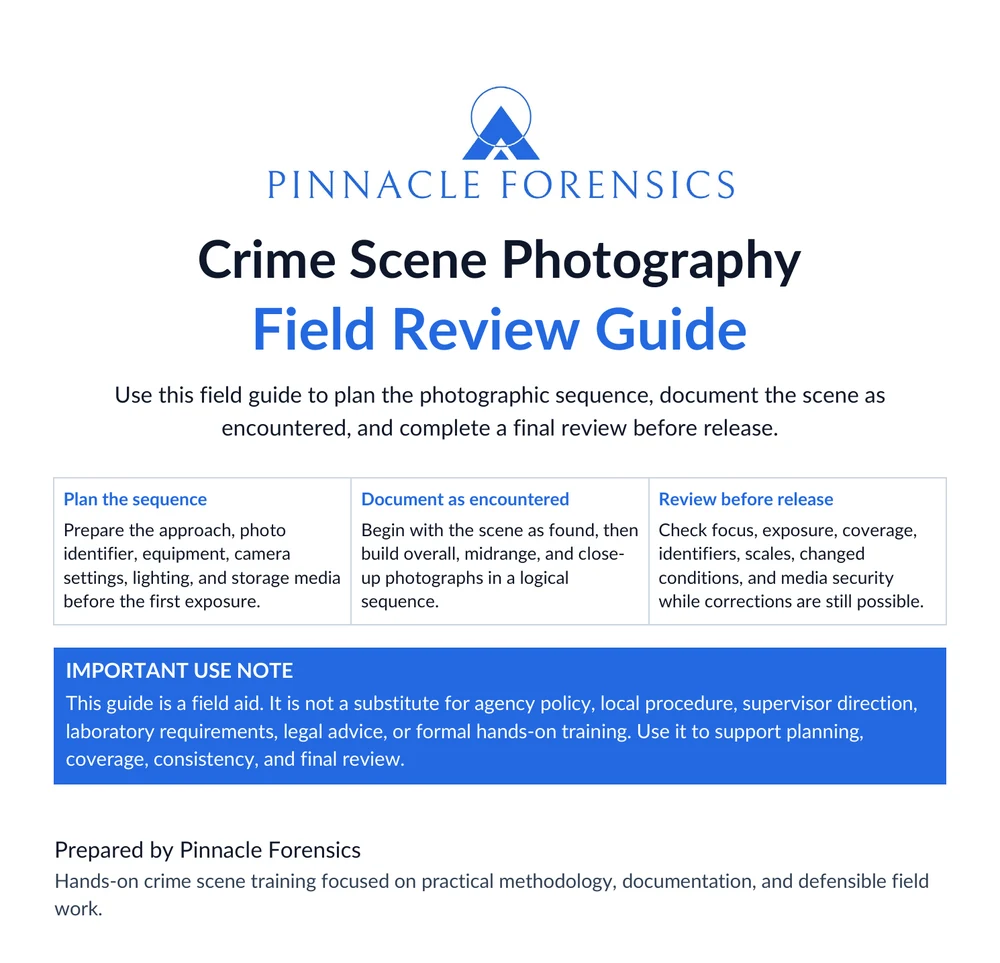
What the guide helps you review
This guide helps law enforcement personnel review key documentation steps before photography begins, during scene work, and before leaving the scene.
01
Plan the photographic sequence
Review the scene approach, photo identifier, camera equipment, settings, lighting, storage media, and documentation sequence before the first exposure.
02
Document the scene as encountered
Use a logical progression from overall photographs to midrange photographs and close-up detail so later reviewers can understand the scene.
03
Review before scene release
Check focus, exposure, coverage, identifiers, scales, changed conditions, and media security while corrections are still possible.
What’s Inside the Crime Scene Photography Field Review Guide
The Crime Scene Photography Field Review Guide is organized as a practical field aid, not a textbook. It gives investigators a structured reminder for the major stages of photographic documentation.
Field documentation sequence
- Before-you-begin preparation
- Core camera equipment
- Overall photographs
- Midrange photographs
- Close-up and scale photographs
Technical and final review topics
- Exposure, focus, and lighting control
- Vehicles, injuries, and special situations
- Final review before leaving the scene
- Common avoidable photography misses
Who this guide is for
This guide is intended for law enforcement personnel who are responsible for documenting scenes, evidence, vehicles, injuries, and related investigative details.
- Patrol officers assigned to photograph scenes
- Crime scene investigators and technicians
- Detectives and investigators documenting evidence
- Supervisors reviewing scene documentation
- Agencies evaluating practical crime scene photography training
Related crime scene photography training
The field guide is designed as a quick reference for use before, during, and after crime scene photography. The full 40-hour Crime Scene Photography course includes the 285-page manual Crime Scene Photography: A Practical Approach to Forensic Documentation (2026), authored by instructor John Calvin Gaziano and provided to each attendee. The course combines this comprehensive manual with hands-on training in camera control, photographic sequencing, exposure, lighting, evidence documentation, injury photography, vehicle photography, low-light scenes, specialized techniques, and report-ready photographic documentation.
Interested in hosting this course? Learn about hosting a Pinnacle Forensics course.